
Korean War Veterans Memorial Guide
What to see at the Korean War Veterans Memorial on the National Mall — the column of nineteen stainless-steel soldiers, the etched granite mural wall, the Pool of Remembrance and the new Wall of Remembrance, why it is unforgettable after dark, and how to pair it with Lincoln and the Vietnam Wall.
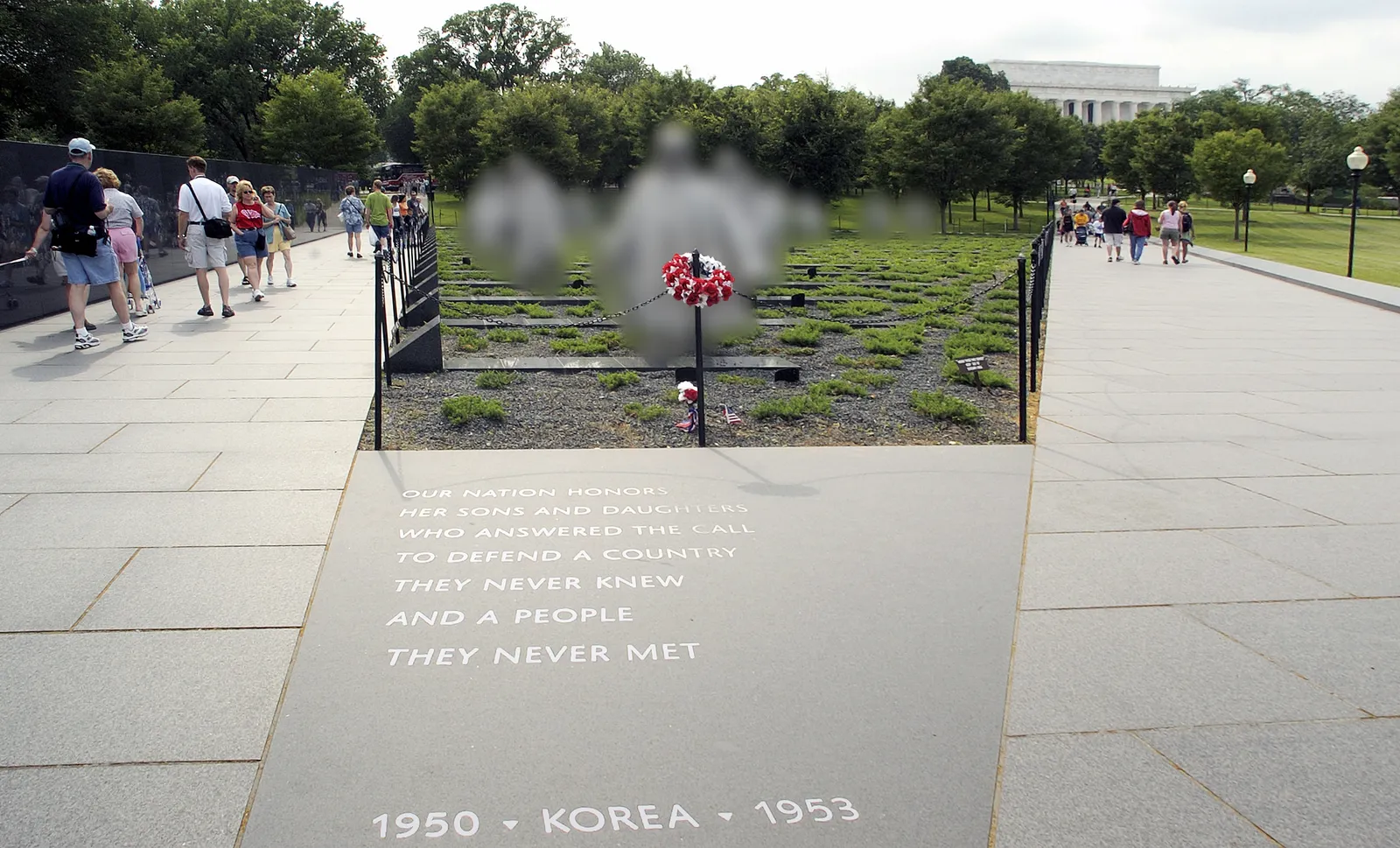
- ✓Nineteen larger-than-life stainless-steel soldiers advance through a field of junipers — a patrol caught mid-step, ponchos blowing in an unseen wind.
- ✓Reflected in the polished granite mural wall, the nineteen become thirty-eight — a nod to the 38th parallel and the war's casualties.
- ✓The granite wall is etched with more than 2,400 faces from wartime photographs, of every branch and role that served.
- ✓The inscription reads 'Freedom Is Not Free' — the Korean War is often called the 'Forgotten War', and this memorial is its answer.
- ✓Free, open and lit 24 hours; the floodlit soldiers after dark are among the most haunting sights on the Mall.
The 'Forgotten War', made impossible to forget
The Korean War sits awkwardly in American memory — bracketed by the Second World War before it and Vietnam after, it has often been called the 'Forgotten War'. Nearly 1.8 million Americans served in it, almost 37,000 of them died, and for decades there was nothing on the Mall to mark that. The Korean War Veterans Memorial, dedicated in 1995, was built to correct that silence, and it does so not with a list of names but with a scene you walk into.
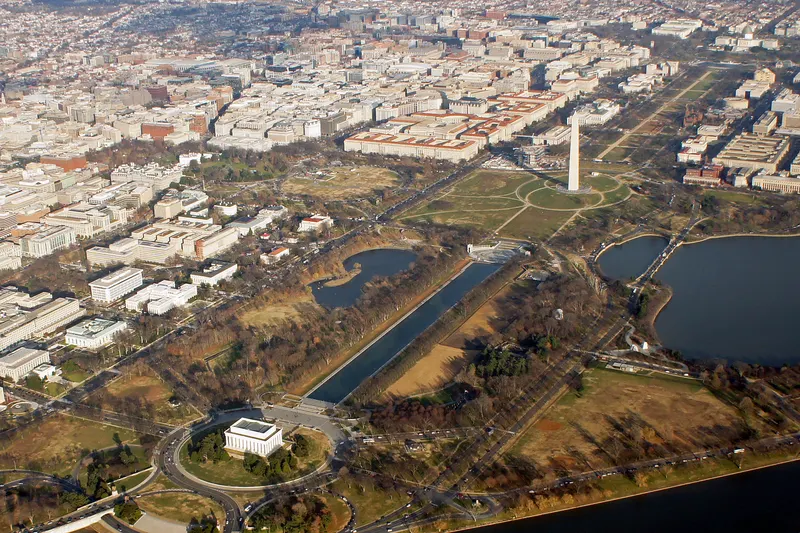
It sits on the south side of the Lincoln Memorial Reflecting Pool, directly across the water from the Vietnam Veterans Memorial — the two war memorials face each other across the Mall's central axis, near the Lincoln Memorial steps. Where the Vietnam Wall pulls you down into the earth and the quiet of names, the Korean memorial does something more theatrical: it puts a column of soldiers on patrol in front of you, moving through rough ground toward an unseen objective, and asks you to walk among them.
It is free, open through the night, and one of the Mall's great after-dark experiences. Many visitors rate the floodlit soldiers at night above anything else on the lawn.


The patrol: nineteen soldiers, and the field they cross
The heart of the memorial is The Column — nineteen stainless-steel figures, each over seven feet tall, advancing in a loose wedge across a triangular field. Sculpted by Frank Gaylord, they represent a squad from every branch and ethnicity that served: most are Army, with a few Marines, a Navy corpsman and an Air Force observer. They wear ponchos that seem to billow in a cold wind, and their faces carry the strain of a patrol through hostile country. Low juniper bushes and granite strips between the figures stand in for the rough Korean terrain, and the whole group seems to be moving toward the American flag and the Pool of Remembrance ahead.
Walk into the field among them — the design invites it — and the effect changes with every step. From some angles the soldiers look wary; from others, exhausted; from others, resolute. Then comes the memorial's quiet masterstroke. To their right runs a long wall of polished black granite, and the nineteen figures are reflected in it. Nineteen plus their nineteen reflections make thirty-eight: a double reference to the 38th parallel that divided Korea, and to the war's thirty-eight months. It is the kind of detail you may not notice until someone points it out, and then cannot un-see.
At night, floodlit and casting long shadows across the junipers, the patrol becomes genuinely eerie — the soldiers seem to keep moving in the corner of your eye. It is the single best reason to make the small effort of seeing this memorial after dark.
- 19 stainless-steel soldiers, over 7 feet tall, by sculptor Frank Gaylord — a squad on patrol across rough ground.
- Reflected in the granite wall, 19 become 38 — for the 38th parallel and the war's 38 months.
- Junipers and granite strips stand in for the Korean terrain the patrol is crossing.
- Best seen after dark, when the floodlit figures cast long shadows.

The mural wall, the Pool of Remembrance and the new Wall
Running alongside the patrol, the 164-foot granite mural wall is etched with more than 2,400 faces taken from actual wartime photographs — pilots, mechanics, nurses, chaplains, supply troops, the vast support effort behind the front line. Sandblasted into the stone, the faces appear and recede depending on the light, and at the right moment they seem to surface out of the granite. The wall's inscription is the memorial's thesis in three words: 'Freedom Is Not Free.'
Ahead of the patrol, the Pool of Remembrance is a shallow circle of water ringed by trees and benches — a deliberately calm counterpoint to the tension of the soldiers. Around it, low markers record the toll of the war in the United States and the United Nations forces: the dead, wounded, captured and missing of a conflict fought under a UN command. Nearby, a granite curb honours the twenty-two nations that contributed troops or medical support.
In 2022 the memorial gained a major addition: the Wall of Remembrance, a low granite wall encircling the Pool of Remembrance, engraved with the names of the Americans and Korean Augmentation troops who died in the war. After decades in which the Korean War had no name wall of its own, this gives families the same chance to find an individual that the Vietnam Wall offers. As with the Vietnam memorial, you can look up a name to find where it falls on the wall.
A little history: why it took until 1995
The Korean War ran from 1950 to 1953 and ended not in victory or defeat but in an armistice that left Korea divided roughly where it had started, along the 38th parallel — a frustrating, inconclusive close that helped consign the war to the margins of public memory. The United States fought under a United Nations mandate alongside South Korea and twenty-one other nations, and the cost was heavy: tens of thousands of Americans dead, far more wounded, and many taken prisoner or never accounted for. Yet for four decades after the guns fell silent, the veterans of Korea had no national memorial in Washington while those of other wars did.
That gap was finally closed in 1995, when President Bill Clinton and South Korean President Kim Young-sam dedicated the memorial on the forty-second anniversary of the armistice. The long delay is part of why the memorial works so hard: it is not just commemorating a war but answering decades of relative neglect, insisting that this service be seen. The design — a patrol you walk among rather than a list you read — was chosen precisely to make the experience visceral rather than abstract, and to give a 'forgotten' war an unforgettable presence on the Mall.
Understanding that backstory changes how the memorial reads. The strain on the soldiers' faces, the cold-weather ponchos, the rough ground, the inscription about the price of freedom — all of it is arguing, quietly but firmly, that this war and its veterans deserve the same place in the national memory as any other.

Visiting respectfully
Like the other war memorials on the Mall, this is a place of commemoration as much as a sight to tick off, and Korean War veterans and their families do come here — increasingly via Honor Flight groups that now bring Korea and Vietnam veterans to Washington. The same simple courtesies apply: keep your voice low, give veteran groups room and a clear path, and if a moment of quiet or applause arises, let it. Children, given a word of explanation about what the patrol represents, almost always rise to the seriousness of the place.
Walking into the field among the soldiers is encouraged by the design — it is not roped off — but do it thoughtfully, watching where you step among the junipers and granite, and be considerate about photographs. The reflections in the mural wall and the night-lit figures are extraordinary to photograph, but the memorial is not a backdrop for cheerful poses any more than a graveside would be. A little restraint is the difference between visiting a monument and understanding one.
If you have a family connection to the Korean War, the 2022 Wall of Remembrance now gives you a name to find, much as the Vietnam Wall has long done — a quiet, personal ritual at the end of the loop.
When to go, and how to pair it
The memorial is open and lit 24 hours, and the case for an after-dark visit is stronger here than almost anywhere on the Mall. The floodlit soldiers, the reflections in the black granite and the faces surfacing from the mural wall are all at their most affecting at night, and the crowds are thin. Failing that, early morning gives you soft light and solitude. Summer middays are hot, busy and the least atmospheric. In winter, a dusting of snow on the soldiers' ponchos is uncannily apt — the war's brutal winters are part of its story.
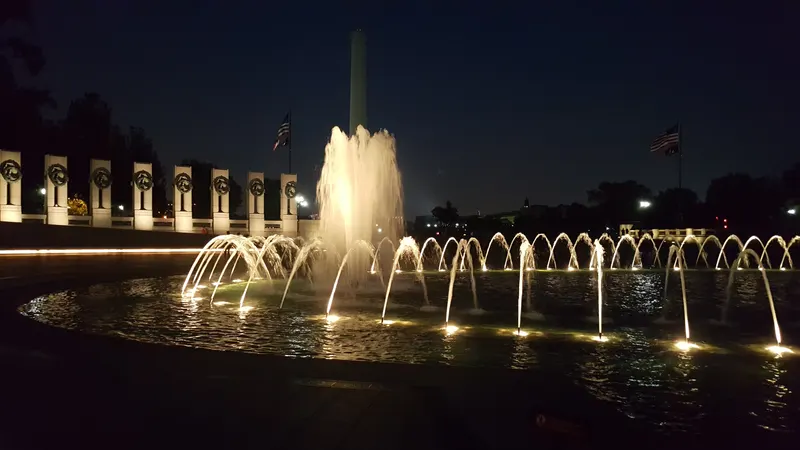
Pair it with its neighbours. Stand on the Lincoln Memorial steps to orient yourself, then drop down to the Korean memorial on the south side of the Reflecting Pool, cross to the Vietnam Veterans Memorial on the north side, and close the loop at the World War II Memorial at the pool's east end. Three of America's defining twentieth-century wars sit within a few minutes' walk of each other here, each handled in a completely different architectural language — together they make one of the most thoughtful short walks in the city, and all of it is free.
Practical notes: the memorial has paved, step-free paths and is wheelchair accessible. The nearest Metro stations are Foggy Bottom–GWU and Smithsonian, both a walk across the Mall. Rangers are usually on duty during the day; treat any specific staffed hours as things to verify with the National Park Service close to your visit. The memorial grounds themselves do not close.

Getting there and around
The memorial sits on the southwest side of the National Mall, on the south flank of the Lincoln Memorial Reflecting Pool. There is no Metro station right on the western Mall — that is a quirk worth planning for — so most visitors arrive on foot from the nearest stops. From Foggy Bottom–GWU on the Orange, Blue and Silver lines it is roughly a fifteen-to-twenty-minute walk south and across the Mall; from Smithsonian on the same lines it is a flatter walk west past the Washington Monument and the World War II Memorial. The Mall is large and deceptively spread out, so wear comfortable shoes and reckon on more walking than the map suggests.
If you would rather not walk the whole Mall, the DC Circulator's National Mall route has long looped past the major monuments for a low flat fare, though routes and operators do change, so check what is currently running before you rely on it. Cycling is another good option — Capital Bikeshare docks sit near the memorials, and the Mall's paths are easy riding — but you walk the memorial itself.
There is no dedicated visitor centre at the Korean memorial, but ranger-staffed information and restrooms are nearby at the Lincoln Memorial and other Mall facilities. Bring water in summer; the western Mall offers little shade between monuments.

At a glance
Location: south side of the Lincoln Memorial Reflecting Pool, opposite the Vietnam Veterans Memorial, on the National Mall.
Cost: free. Open 24 hours and floodlit at night; rangers usually on duty daytime (verify seasonal hours with NPS).
Time needed: 20–40 minutes; longer if you are finding a name on the Wall of Remembrance.
Key elements: 19 stainless-steel soldiers (reflected to 38), the etched granite mural wall, the Pool of Remembrance and the 2022 Wall of Remembrance. Dedicated 1995.
Nearest Metro: Foggy Bottom–GWU or Smithsonian. Step-free paved access.
Related guides
Vietnam Veterans Memorial Guide
A respectful guide to the Vietnam Veterans Memorial on the National Mall — Maya Lin's black-granite Wall, how to find a name, the Three Servicemen and Vietnam Women's Memorial statues, the etiquette of visiting, and how to pair it with the Lincoln and Korean War memorials.
Read guide
Lincoln Memorial Guide, Washington, D.C.
When to visit the Lincoln Memorial, the views from its steps, how to reach it by Metro, the Reflecting Pool route and what to notice inside — the marble statue, the Gettysburg Address and the history made on these steps.
Read guide
Washington, D.C. Monuments by Night
An atmospheric, sensible evening route through Washington's floodlit memorials — the Lincoln, the war memorials, the Tidal Basin loop and the Washington Monument — with self-guided and guided-tour options, and honest safety advice.
Read guide