
FDR Memorial Guide
How to visit the Franklin Delano Roosevelt Memorial — four open-air granite rooms of waterfalls, statues and carved quotes along the Tidal Basin, and how to walk it in order.
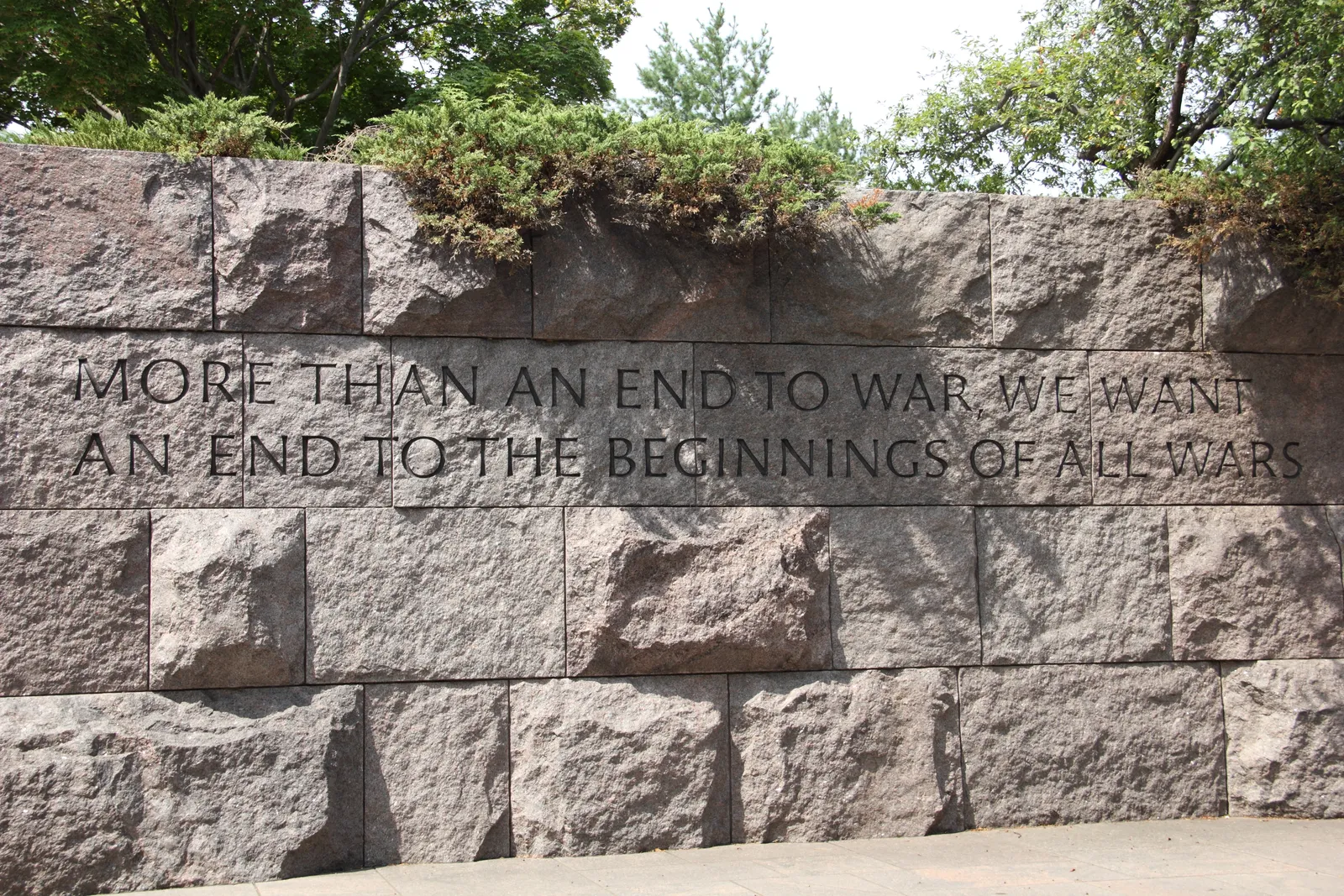
Photo: Caroline Léna Becker / Wikimedia Commons · CC BY 3.0
- ✓Not a single monument but a sequence of four open-air granite 'rooms,' one for each of Roosevelt's four terms as president.
- ✓Waterfalls run through every room — the water gets louder and more turbulent as you move through the years of the Depression and the war.
- ✓Famous bronze sculpture groups include a Depression breadline, a man at a radio, and FDR seated with his dog Fala.
- ✓It was the first presidential memorial designed from the start to be fully wheelchair-accessible — flat, paved and step-free throughout.
- ✓A later addition near the entrance shows FDR in his wheelchair, acknowledging the polio he largely kept from public view.
A memorial you walk through
The Franklin Delano Roosevelt Memorial is the most unusual of the Tidal Basin memorials, because it isn't a building or a statue — it's a journey. Spread along the basin's western shore is a sequence of four outdoor 'rooms,' each defined by walls of rough red granite, each devoted to one of Roosevelt's four terms in office. You don't stand and look at this memorial; you walk through it, room by room, from the early Depression years to the Second World War, and it tells its story as you move.
Running through all of it is water. Every room has a waterfall or pool, and the designers used the water as narrative: it begins calm, grows broader, and turns to crashing, chaotic cascades by the room that covers the war, before settling again at the end. Bronze sculptures punctuate the rooms — a Depression-era breadline of weary men, a figure hunched at a radio listening to a fireside chat, and FDR himself seated in a cloak with his Scottish terrier, Fala, at his side. It is a memorial built for lingering, and it rewards the slow walk far more than a quick glance.
It opened in 1997, after decades of debate, and it sits comfortably on the basin loop between the Martin Luther King Jr. Memorial and the Jefferson — a quieter, more contemplative stop than either, and a welcome change of pace.


At a glance
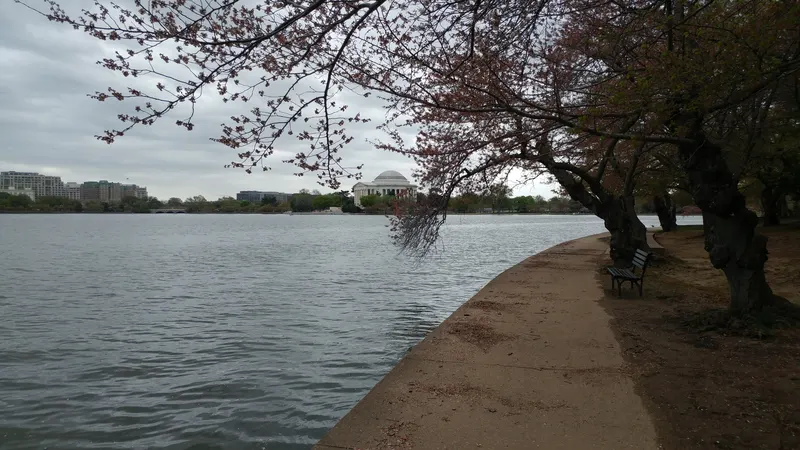
A quick orientation before you walk it. Treat staffed hours and the waterfall-running months as things to confirm on the National Park Service page near your visit; the memorial grounds stay open and free at all hours.
- What it is: a memorial to Franklin Delano Roosevelt, 32nd U.S. president, told as four open-air granite 'rooms' — one per term.
- Where: the western shore of the Tidal Basin, between the MLK and Jefferson memorials.
- Opened: 1997, after decades of debate over its design and scale.
- Cost: free, open 24 hours; rangers and a bookstore during staffed daytime hours (verify on the NPS page).
- Access: the first presidential memorial designed to be fully step-free; flat and paved throughout.
- Time needed: 30 minutes or more — you walk through it, so it absorbs more time than a single statue would.
- Best for: a slower, reflective stop, the waterfalls in mild months, and an accessible memorial walk.
Walking the four rooms in order
The memorial is designed to be read in sequence, so it's worth checking you start at the right end — the rooms run chronologically through Roosevelt's terms, and walking them in order is the whole point. Carved into the granite walls throughout are some of his best-known lines, including 'The only thing we have to fear is fear itself,' set among the panels so that his words become part of the architecture. Read as you go; the quotes are the memorial's narration.
Watch for the set-piece sculptures as you pass through: the breadline and the rural couple from the Depression years, the listener at the radio, and the great seated figure of FDR with Fala — whose bronze nose is rubbed bright by decades of visitors' hands. Near the memorial's entrance, a statue added later shows Roosevelt seated in a wheelchair, a deliberate acknowledgment of the polio he lived with and largely concealed from the public during his presidency. It's a quietly powerful note to begin or end on.
- Four granite rooms, one per term — walk them in chronological order for the story to land.
- Carved quotations throughout, including 'The only thing we have to fear is fear itself.'
- Bronze groups: the Depression breadline, the fireside-chat listener, and FDR with his dog Fala.
- The wheelchair statue near the entrance — a later addition recognising FDR's disability.
- Waterfalls that build from calm to turbulent as you move through the Depression and the war.
The wheelchair statue and a quiet debate
One of the memorial's most interesting features wasn't part of the original plan. When it opened in 1997, FDR was shown seated but with his disability largely hidden — a cloak draped over the chair so the wheels barely showed, much as Roosevelt himself had managed his image during his presidency, when he was rarely photographed in his wheelchair. Disability-rights advocates argued that a modern memorial should be honest about the polio that shaped his life, and after public campaigning a second statue was added near the entrance, dedicated in 2001: FDR seated plainly in a wheelchair of his own design.
It's a small addition that changes how the whole memorial reads. Roosevelt led the country through the Depression and most of the Second World War from a wheelchair, at a time when that was kept from the public — and the entrance statue makes the visit start with that truth rather than around it. It's also part of why the FDR Memorial has become a touchstone for accessible design, the first presidential memorial built so that every visitor can move through every room.
Accessibility, hours and the best light
The FDR Memorial was the first presidential memorial planned from the outset to be fully accessible, and it shows: the entire route is flat, paved and step-free, easy for wheelchairs and strollers, with tactile and braille elements included for visitors with low vision. Of all the memorials on the Mall, this is among the gentlest to move through — fitting, given the president it honours.
Like the other Tidal Basin memorials, it's outdoors, free and open around the clock, with rangers and a bookstore during staffed daytime hours (verify times on the NPS page). The waterfalls are the draw, so visit when they're running — they're typically turned off in the coldest months to prevent freezing, which is worth knowing if water is what you've come for. The granite glows warmly at sunset and the rooms are softly lit after dark, when the crowds fall away and the sound of the water carries; early morning is the other calm window, especially in cherry-blossom season when the basin fills up.
- Fully step-free and accessible throughout — flat paved paths, with tactile and braille elements.
- Outdoors, free, open 24 hours; rangers and a bookstore during staffed daytime hours (verify on the NPS page).
- Waterfalls usually run except in the coldest months — visit in milder weather to see them flowing.
- Dusk and early morning are the quietest and most atmospheric; the granite warms beautifully at sunset.
Getting there and pairing it well
There's no Metro station at the door — like the rest of the Tidal Basin memorials, the FDR is reached on foot, and the most rewarding approach is as part of the basin loop. It sits between the Martin Luther King Jr. Memorial just to the north and the Jefferson Memorial around the water to the south, so the obvious plan is to walk all three together: a flat, scenic circuit of roughly two miles that takes in the best of the basin, the cherry blossoms in season, and the city's finest sunset reflections.
Allow more time here than you'd expect — because you walk through it, the FDR easily absorbs half an hour or more if you read the quotes and let the rooms unfold. Save it for late afternoon if you can, so you finish the loop at the Jefferson for sunset, and you'll have one of the best free walks in Washington in the bag.
Practical notes and small cautions
A few practical points smooth the visit. There's no food or drink for sale at the memorial, and the Tidal Basin shore is open and largely shadeless, so carry water in warm months — the rooms are pleasant in spring and autumn but exposed under the full summer sun. Restrooms around the basin are limited, so use the facilities at a Smithsonian museum before you set out, and allow more time here than the map suggests, because the walk-through layout naturally slows you down.
Because the memorial runs in chronological order, it pays to enter at the correct end and read the rooms as a sequence — wander in backwards and the story reads in reverse. If the waterfalls are why you've come, remember they're usually shut off in the coldest stretch of winter to prevent freezing, so check before a December or January visit. And while children often love clambering near the breadline figures and rubbing Fala's bright bronze nose, it's worth a quiet reminder that this is still a memorial to a wartime president and the hardships of the Depression.
Most of all, give the FDR the time its design asks for. It is the one Tidal Basin memorial you can't take in at a glance — the whole point is to move through it, room by room, letting the water and the quotes carry the years. Folded into the basin loop with the MLK and Jefferson memorials, it turns a walk around the water into one of the most rewarding free hours in Washington.

Related guides
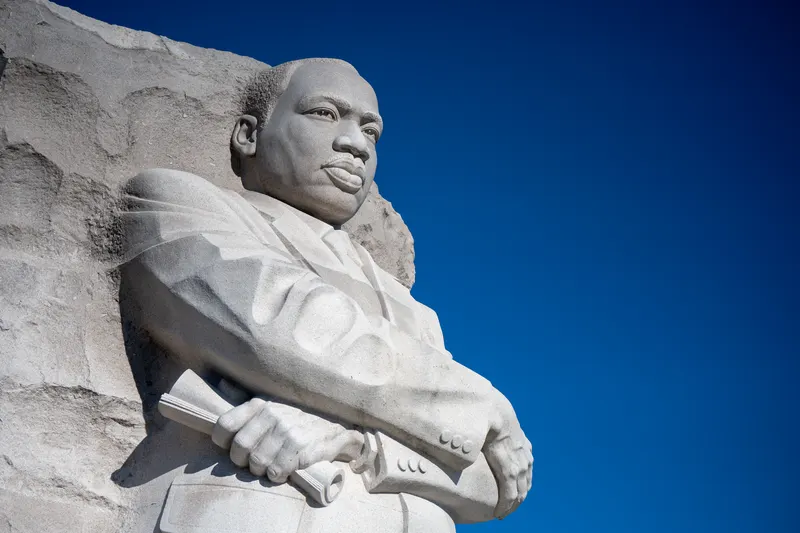
Martin Luther King Jr. Memorial Guide
A respectful guide to the Martin Luther King Jr. Memorial on the Tidal Basin — the Stone of Hope, the inscription wall, what to read, and how to visit it as part of a memorial walk.
Read guide
Jefferson Memorial Guide
How to visit the Jefferson Memorial — the domed rotunda on the Tidal Basin, the cherry-blossom and sunset views, the bronze statue inside, and how to walk it without over-walking.
Read guide
Accessible Washington, D.C.
How to visit Washington with mobility, distance or stamina in mind — the step-free Metro, the largely flat but very long Mall, accessible museums and memorials, taxis and rideshare, and ways to build a low-walking plan that still reaches the city's best places.
Read guideMore in Things to Do
6
African American History Museum Guide
How to visit the National Museum of African American History & Culture on the Mall — the free timed-entry passes and how to get one, the deep underground history galleries, Sweet Home Café, the lines, how to pace an emotionally heavy visit, and the walk along the Mall.
Read guide
American History Museum Guide
How to visit the National Museum of American History on the Mall — the original Star-Spangled Banner, the First Ladies' gowns, the American presidency, the pop-culture icons, the food-court logistics, and how to time a visit around the school groups.
Read guide
Best Museums in Washington, D.C.
Washington has more world-class museums than any sane trip can hold, and almost all of them are free. This is a guide to the best museums in DC sorted by topic, age, ticket needs, location and rainy-day value — so you can choose two or three with confidence instead of trying to see them all.
Read guide
Best Photography Spots in Washington, D.C.
Where to make great photographs in Washington — the monument reflections, the Tidal Basin blossoms, the Capitol and Lincoln axis, Georgetown's waterfront, hidden rooftops and the golden-hour and blue-hour routes that tie them together.
Read guide
Best Things to Do in Washington, D.C.
A ranked first-trip shortlist of the best things to do in Washington, D.C. — from the National Mall and the free Smithsonian museums to a Capitol tour, the Tidal Basin and Georgetown — built so you can pick a handful and still feel you saw the city.
Read guide
Best Viewpoints in Washington, D.C.
Where to find the best views in Washington — the high monuments and free towers, the rooftop bars and cultural terraces, and the river and hilltop overlooks across the Potomac, ranked by how much effort each one asks.
Read guide